The close is a pipeline problem, not a people problem
Nine-day closes are not caused by slow accountants. They are caused by 5 tools that each hold a different version of the truth.
Every finance team that closes slowly tells the same story, and it is never about effort. The team is working late. The problem is that the numbers arrive from 5 directions and disagree on the way in.
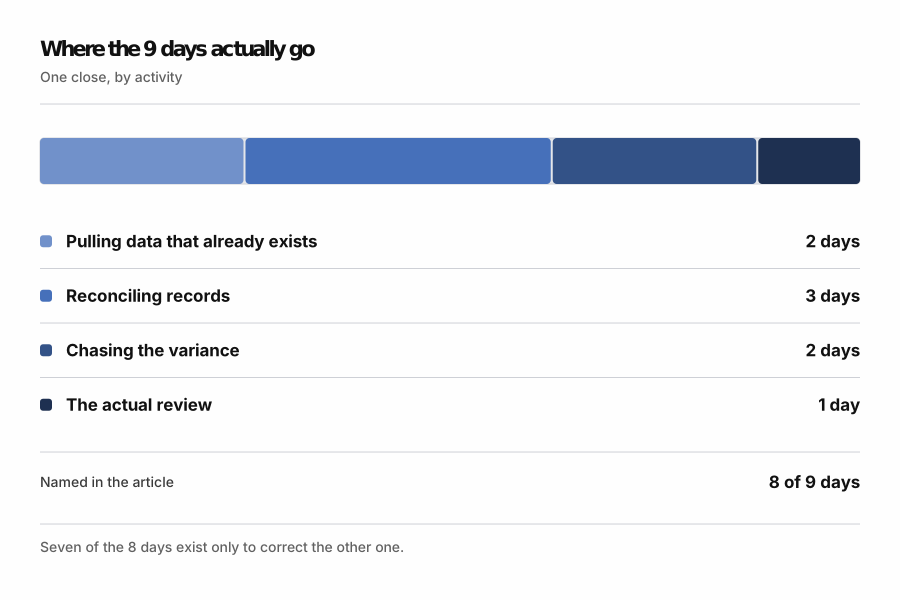
Where the 9 days actually go
Pull the timesheet of a 9-day close and the analysis is rarely more than a day of it. The rest is acquisition and reconciliation: exporting from billing, exporting from the CRM, exporting from the payment processor, then building the bridge that explains why the 3 do not agree.
- Two days pulling data that already exists in a system you own
- Three days reconciling records that were never designed to reconcile
- Two days chasing the variance to something you can write down
- One day on the actual review
By the time anyone could ask a question about the month, the month was nearly over.
One record, not 5 exports
The alternative is not a better spreadsheet. It is refusing to let the versions diverge in the first place: contracts, usage events, invoices and payments land once, in one model, and everything downstream, the invoice, the recognition schedule, the metric on the dashboard, is derived from that same record rather than copied from it.
When the derivation is the only path, reconciliation stops being a task. There is nothing to reconcile, because there was never a second copy to disagree with the first.
See it in the product: Revenue recognitionASC 606 schedules and journal entries built from the contract, without the spreadsheet.
What changes, by billing shape
A per-seat book goes from 9 days to a day and a half. A metered book stops needing a variance memo for 41 million events. A services book replaces the milestone spreadsheet only one person fully understands. None of it takes another hire.
The close did not get faster because the people got faster. It got faster because the pipeline stopped producing work that only existed to correct itself.
Related
Keep reading
Usage metering 101: build vs. buy the infrastructure behind accurate billing
Usage metering is the foundation every usage-based billing model depends on. See how metering pipelines work, the real cost of building your own, and when to buy instead.
Anubhav DubeyCredit-based pricing explained: why credits are a bridge, not the destination
Credit-based pricing is everywhere in AI billing right now, but it's a transitional model, not an endpoint. Here's how credits work, why they confuse buyers, and what comes after.
Anubhav DubeyClosing the month on the first
Why a close takes 9 days, and which of them are just arithmetic waiting to happen.
Anubhav Dubey